
Vincent GRUNEWALD
Vincent Grunewald (71) x Cheval Paysages (26)
WHO IS HE?
After earning a BTS in landscape architecture and taking a gap year to travel, Vincent Grunewald completed his studies at the ITIAPE engineering school. In 2017, one year after graduating, he started his own business in Cavaillon. Having always been conscious of environmental protection, it was only natural for Vincent to focus his garden architecture practice on the ecological transition of outdoor spaces. Now based in Mâcon, he carefully advises and guides his clients in making responsible, forward-thinking choices. He offers a working methodology based on collaboration with clients and craftsmen. A plant lover, he pays special attention to existing vegetation and blurs the boundaries between the garden to be designed and the surrounding landscape. His special touch? Vincent pays particular attention to reusing materials and proves that, with creativity, anything can be brought up to date.

HIS PROJECT: "L’ENTRE DEUX BRUITS"
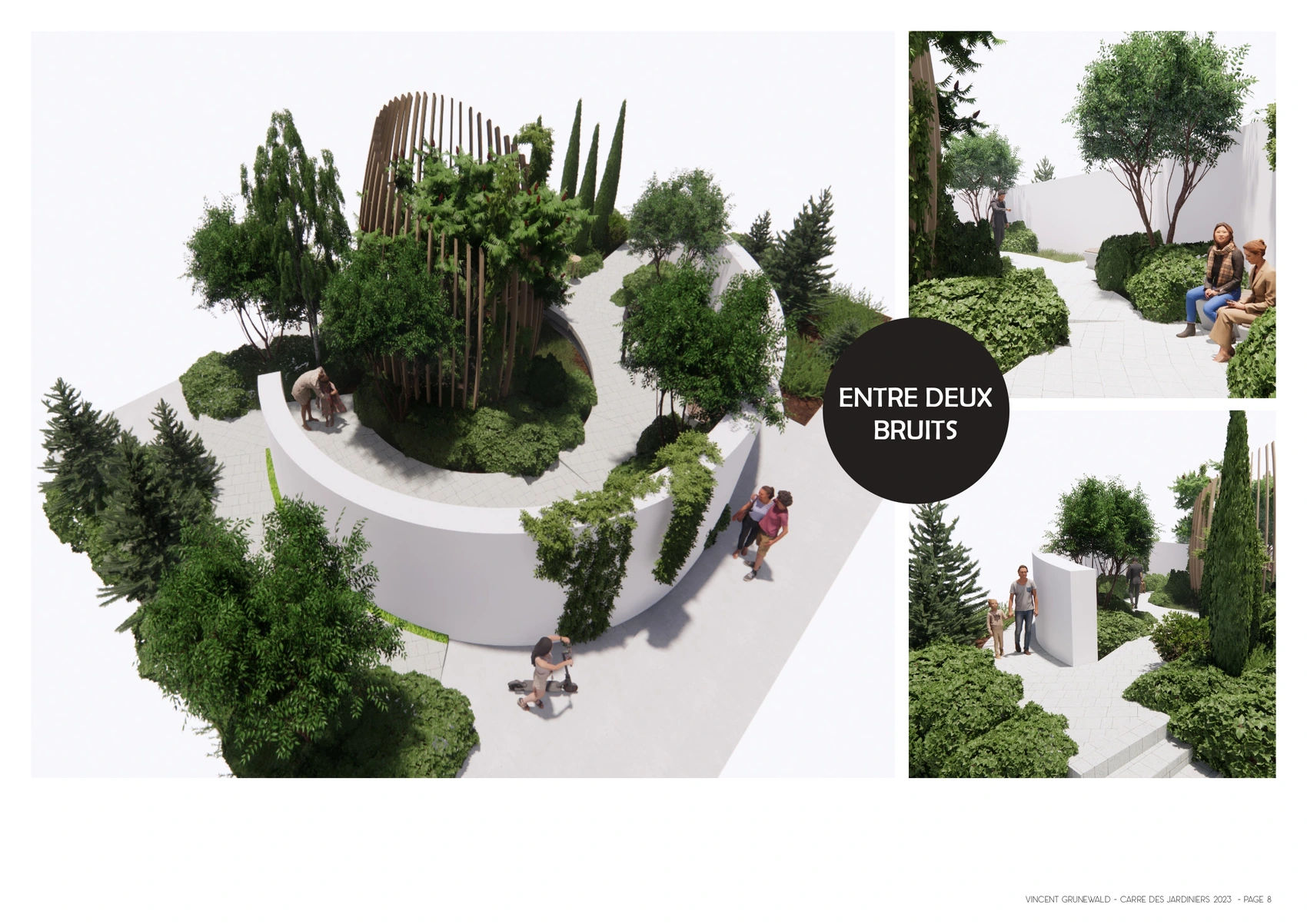
There is no single model for a city. However, cities often share a high volume of traffic and activity necessary to allow their residents to get around, eat, find housing, and enjoy themselves… This intensity generates noise that can be perceived as a nuisance. Parks and gardens thus serve as true sanctuaries where one can temporarily escape the relentless rhythm of the city. This is the starting point of my reflection: How can we enable residents to recharge their batteries away from the city’s noise? The city can no longer expand sustainably. It must now rebuild itself, uncover abandoned and underutilized spaces, optimize every square foot, reuse materials on-site, and protect existing vegetation. Our proposal therefore seeks to integrate into small spaces to offer city dwellers local green spaces and places of rest. “L’entre deux bruits” is a garden composed of two major elements: a noise barrier and a large central wooden structure. The garden is accessed via four entrances that converge around the wooden structure. The city is vast, and gardens must connect the different neighborhoods. Two entrances are wheelchair-accessible, and the other two require climbing a staircase of three steps. The wooden structure serves as a focal point, a beacon in the city that guides visitors seeking greenery through the urban hustle and bustle. The structure rises majestically above the wall, offering a haven of peace for urban flora and fauna, as well as a green oasis for those who take the time to pause and admire it. Its oval shape symbolizes the birth of a fragile, vulnerable, evolving ecosystem that never ceases to captivate the eye. The lower section is concealed but pierced here and there by a few openings that will delight the most curious. Inside, trees, vines, and berry-bearing shrubs live and die at the mercy of the winds and wildlife, free from human intervention. Seated, people witness a living, slow, and uninterrupted spectacle led by unknown and often invisible actors. Like a temporary shield against the city’s noise, an acoustic wall envelops the garden and its users, offering, at its center, a moment of rest, a restorative pause. The city’s noises are thus minimized, and the sounds of nature become perceptible once more, audible like a distant memory of seclusion. The wall serves multiple functions within this small garden. In addition to its acoustic function, it provides seating, offers storage for scooters, shelters microfauna in its upper section, informs users about the fragility of the environment before their eyes, and allows them to express themselves freely across an entire wall. Some of the materials and plants that make up this garden have already had a first life. Unsold, salvaged from demolition, and considered waste, they were destined for composting, incineration, or landfilling. Here, there are no palm trees or bamboo, but rather local plants—resilient and beautiful by nature.
An event:

Co-produced with: